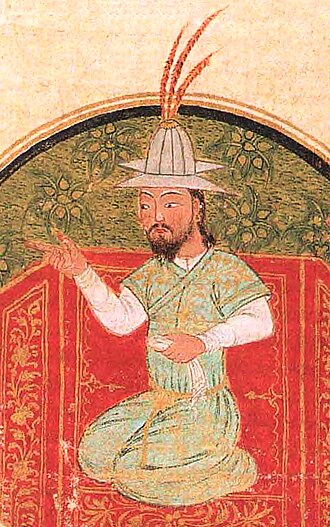
Fun Facts About Timur
- Timur's tomb was opened by Soviet scientists on 19 June 1941. A story called the Curse of Timur says an inscription warned of an invader, and three days later Germany invaded the Soviet Union.[1]
- The name Tamerlane comes from the Persian for Timur the Lame. He was believed to have been hit by two arrows while stealing a sheep, injuring his right leg and costing him two fingers.[1]
- Timur is credited with inventing Tamerlane chess, a variant played on a 10×11 board.[1]
- Facing armored war elephants, Timur sent camels loaded with burning hay charging at them. The panicked elephants turned and stampeded back toward their own lines.[1]
- Timur's name, Temur, means iron in Chagatai, his mother tongue.[1]
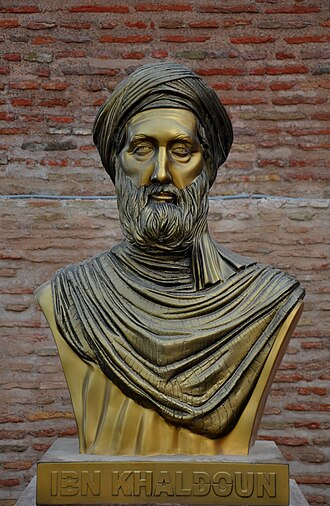
- The historian Ibn Khaldun met Timur in person in Damascus in 1401, and later praised him for unifying much of the Muslim world.[1][3][4]
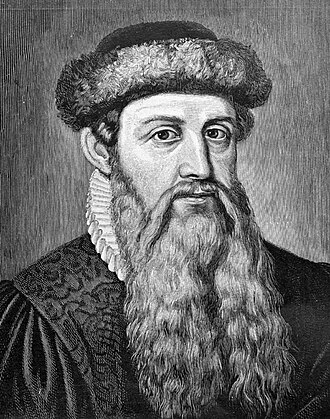
- Timur was alive at the same time as Johannes Gutenberg — their lives overlapped for about 5 years (c. 1400–1405).[1][2][5][6]
- Timur lived to about 77, from c. 1328 until 1405.[1][2]
Timur, also known as Tamerlane, was a Turco-Mongol conqueror, first ruler of the Timurid dynasty, and the founder of the Timurid Empire, which ruled over modern-day Afghanistan, Iran, and Central Asia. He was undefeated in battle and is widely regarded as one of the greatest military leaders and tacticians in history, as well as one of the most brutal and deadly. Timur is also considered a great patron of the arts, for he interacted with scholars and poets such as ibn Khaldun, Hafez, and Hafiz-i Abru. His reign led to the Timurid Renaissance.[1]
Read more on Wikipedia →Contemporaries
Their World
Questions About Timur
When was Timur born?
Timur was born about 1328 and died in 1405.
How old was Timur at death?
Timur died in 1405 at about 77 years old (c. 1328–1405).
What was Timur known for?
Timur was known for: Turco-Mongol conqueror of Central Asia. Timur, also known as Tamerlane, was a Turco-Mongol conqueror, first ruler of the Timurid dynasty, and the founder of the Timurid Empire, which ruled over modern-day Afghanistan, Iran, and Central Asia. He was undefeated in battle and is widely regarded as one of the greatest military leaders and tacticians in history, as well as one of the most brutal and deadly. Timur is also considered a great patron of the arts, for he interacted with scholars and poets such as ibn Khaldun, Hafez, and Hafiz-i Abru. His reign led to the Timurid Renaissance.
Who was alive at the same time as Timur?
Timur's closest contemporary was Ibn Khaldun. Their lives overlapped for 73 years.
Sources
- Timur — Wikipedia. Text available under CC BY-SA 4.0
- Timur (Q8462) — Wikidata
- Ibn Khaldun — Wikipedia
- Ibn Khaldun (Q9294) — Wikidata
- Johannes Gutenberg — Wikipedia
- Johannes Gutenberg (Q8958) — Wikidata
- Portrait: Timur seated (earliest known portrait), Timurid genealogy, 1405-1409, Samarkand (TSMK, H2152).jpg — Wikimedia Commons. 1405-1409 artist, Public domain