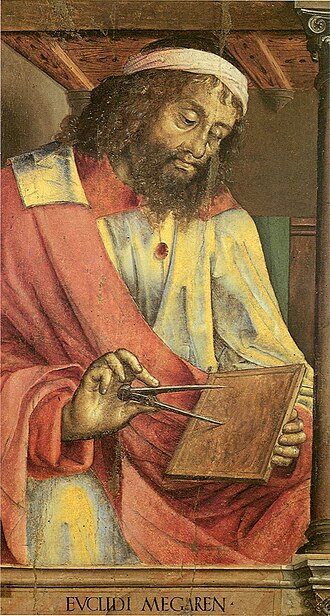
Fun Facts About Euclid
- Euclid's Elements is often considered the most frequently translated, published and studied book in Western history after the Bible.[1]
- Medieval scholars confused Euclid with Euclid of Megara, an earlier philosopher and pupil of Socrates, and credited him with details of both men's lives.[1][3][4]
- Euclid's famous reply that "there is no royal road to geometry" is questionable, because a very similar exchange is recorded between Menaechmus and Alexander the Great.[1][5][6]
- Euclid's Elements is not only about geometry. Its books on number theory include the proof, now called Euclid's theorem, that there are infinitely many prime numbers.[1]
- Euclid's Greek name, Eukleides, means roughly "renowned, glorious". In English, "Euclid" is sometimes used as a synonym for geometry itself.[1]
- According to Proclus, one of Euclid's lost works, the Pseudaria or "Fallacies", was written to help beginners avoid common mistakes in geometrical reasoning.[1]
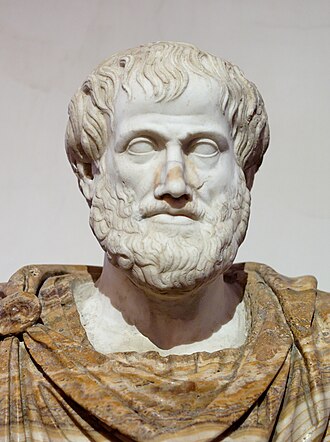
- Euclid was alive at the same time as Aristotle — their lives overlapped for about 3 years (c. 325 BCE–322 BCE).[1][2][7][8]
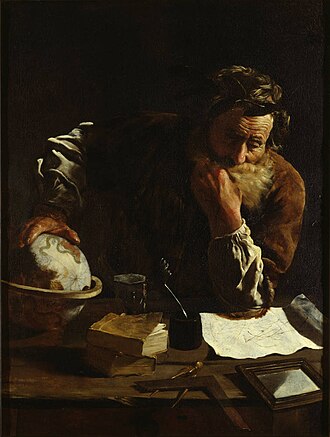
- Euclid was alive at the same time as Archimedes — their lives overlapped for about 22 years (c. 287 BCE–c. 265 BCE).[1][2][9][10]
Euclid was an ancient Greek mathematician active as a geometer and logician. Considered the "father of geometry", he is chiefly known for the Elements treatise, which established the foundations of geometry that largely dominated the field until the early 19th century. His system, now referred to as Euclidean geometry, involved innovations in combination with a synthesis of theories from earlier Greek mathematicians, including Eudoxus of Cnidus, Hippocrates of Chios, Thales and Theaetetus. With Archimedes and Apollonius of Perga, Euclid is generally considered among the greatest mathematicians of antiquity, and one of the most influential in the history of mathematics.[1]
Read more on Wikipedia →Contemporaries
Questions About Euclid
When was Euclid born?
Euclid was born about 325 BCE and died about 265 BCE. The exact dates are not known.
What was Euclid known for?
Euclid was known for: Father of geometry, wrote Elements. Euclid was an ancient Greek mathematician active as a geometer and logician. Considered the "father of geometry", he is chiefly known for the Elements treatise, which established the foundations of geometry that largely dominated the field until the early 19th century. His system, now referred to as Euclidean geometry, involved innovations in combination with a synthesis of theories from earlier Greek mathematicians, including Eudoxus of Cnidus, Hippocrates of Chios, Thales and Theaetetus. With Archimedes and Apollonius of Perga, Euclid is generally considered among the greatest mathematicians of antiquity, and one of the most influential in the history of mathematics.
Who was alive at the same time as Euclid?
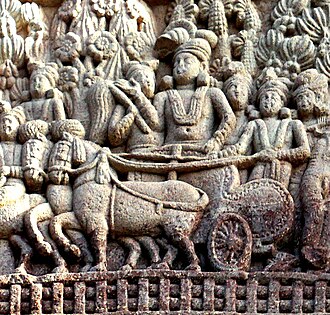
Euclid's closest contemporary was Ashoka. Their lives overlapped for 39 years.
Sources
- Euclid — Wikipedia. Text available under CC BY-SA 4.0
- Euclid (Q8747) — Wikidata
- Socrates — Wikipedia
- Socrates (Q913) — Wikidata
- Alexander the Great — Wikipedia
- Alexander the Great (Q8409) — Wikidata
- Aristotle — Wikipedia
- Aristotle (Q868) — Wikidata
- Archimedes — Wikipedia
- Archimedes (Q8739) — Wikidata
- Portrait: Euklid2.jpg — Wikimedia Commons. Justus van Gent, Public domain