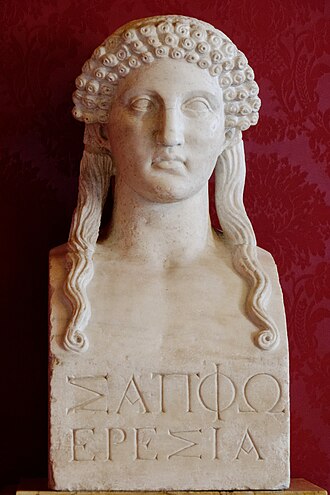
Fun Facts About Sappho
- Sappho probably wrote around 10,000 lines of poetry, but only about 650 survive, and just one of her poems, the Ode to Aphrodite, is complete.[1]
- Legend says the church burned Sappho's poems for their immorality, but the stories date from the Renaissance. Her work was more likely lost because too few people wanted copies made.[1]
- The famous story that Sappho leapt to her death from the Leucadian cliffs for love of a ferryman named Phaon is regarded as ahistorical by modern scholars.[1]
- Ancient writers called Sappho the tenth Muse, and she was known as The Poetess just as Homer was The Poet. One such tribute is attributed to Plato.[1][3][4][5][6]
- Many lost fragments of Sappho were found in an ancient rubbish dump at Oxyrhynchus in Egypt, and new poems, including the Brothers Poem, turned up as recently as 2014.[1]
- Sappho's supposed husband, Kerkylas of Andros, was probably a joke by a comic poet: the name puns on Greek words for penis and man.[1]
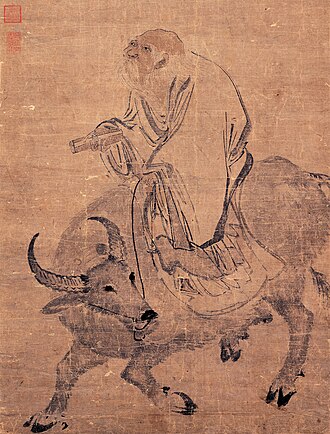
- Sappho was alive at the same time as Lao Tzu — their lives overlapped for about 1 year (c. 571 BCE–c. 570 BCE).[1][2][7][8]
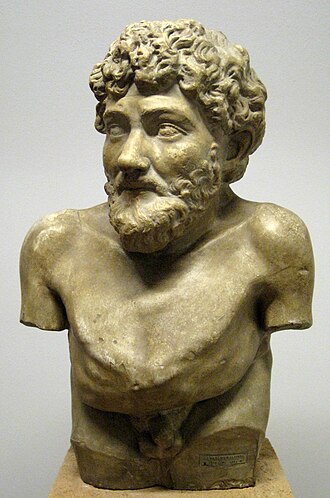
- Sappho was alive at the same time as Aesop — their lives overlapped for about 50 years (c. 620 BCE–c. 570 BCE).[1][2][9][10]
Sappho was an Ancient Greek poet from Eresos or Mytilene on the island of Lesbos. Sappho is known for her lyric poetry, written to be sung while accompanied by music. In ancient times, Sappho was widely regarded as one of the greatest lyric poets and was given names such as the "Tenth Muse" and "The Poetess". Most of Sappho's poetry is now lost, and what is not has mostly survived in fragmentary form; only the Ode to Aphrodite is certainly complete. As well as lyric poetry, ancient commentators claimed that Sappho wrote elegiac and iambic poetry. Three epigrams formerly attributed to Sappho have survived, but these are actually Hellenistic imitations of Sappho's style.[1]
Read more on Wikipedia →Contemporaries
Questions About Sappho
When was Sappho born?
Sappho was born about 630 BCE and died about 570 BCE. The exact dates are not known.
What was Sappho known for?
Sappho was known for: Greatest lyric poet of ancient Greece. Sappho was an Ancient Greek poet from Eresos or Mytilene on the island of Lesbos. Sappho is known for her lyric poetry, written to be sung while accompanied by music. In ancient times, Sappho was widely regarded as one of the greatest lyric poets and was given names such as the "Tenth Muse" and "The Poetess". Most of Sappho's poetry is now lost, and what is not has mostly survived in fragmentary form; only the Ode to Aphrodite is certainly complete. As well as lyric poetry, ancient commentators claimed that Sappho wrote elegiac and iambic poetry. Three epigrams formerly attributed to Sappho have survived, but these are actually Hellenistic imitations of Sappho's style.
Who was alive at the same time as Sappho?
Sappho's closest contemporary was Aesop. Their lives overlapped for 50 years.
Sources
- Sappho — Wikipedia. Text available under CC BY-SA 4.0
- Sappho (Q17892) — Wikidata
- Homer — Wikipedia
- Homer (Q6691) — Wikidata
- Plato — Wikipedia
- Plato (Q859) — Wikidata
- Laozi — Wikipedia
- Lao Tzu (Q9333) — Wikidata
- Aesop — Wikipedia
- Aesop (Q43423) — Wikidata
- Portrait: Bust Sappho Musei Capitolini MC1164.jpg — Wikimedia Commons. Marie-Lan Nguyen, Public domain