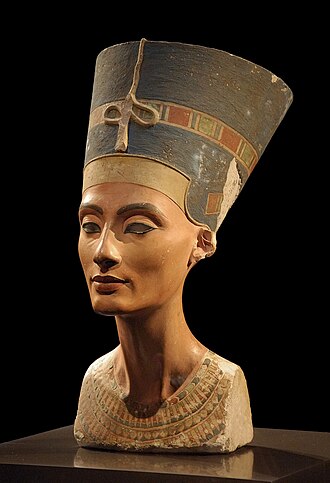
Fun Facts About Nefertiti
- Nefertiti's name means "the beautiful one has come," and in her own time it was probably pronounced something like Naftita.[1]
- Nefertiti's famous bust, now in Berlin, is attributed to the sculptor Thutmose and was dug up from his buried studio in the early 20th century.[1]
- Nefertiti is shown in art smiting Egypt's enemies and riding a chariot, and some scholars believe she may have ruled as a female pharaoh, though this is debated.[1]
- In 2015 an archaeologist proposed that Nefertiti's burial chamber lay hidden behind the walls of Tutankhamun's tomb, but later radar scans found no hidden chambers.[1]
- Nefertiti and Akhenaten had at least six daughters, one of whom, Ankhesenamun, married Tutankhamun.[1]
- Almost nothing is known about Nefertiti's life before her marriage; the courtier Ay may have been her father, but no source names her parents.[1]
Nefertiti was a queen of the 18th Dynasty of Ancient Egypt, the great royal wife of Pharaoh Akhenaten. Nefertiti and her husband were known for their radical overhaul of state religious policy, in which they promoted an exclusivist and possibly even monotheistic religion, Atenism, centered on the sun disc and its direct connection to the royal household. With her husband, she reigned at what was arguably the wealthiest period of ancient Egyptian history.[1]
Read more on Wikipedia →Contemporaries
Questions About Nefertiti
When was Nefertiti born?
Nefertiti was born about 1370 BCE and died about 1330 BCE. The exact dates are not known.
What was Nefertiti known for?
Nefertiti was known for: Egyptian queen, icon of feminine beauty. Nefertiti was a queen of the 18th Dynasty of Ancient Egypt, the great royal wife of Pharaoh Akhenaten. Nefertiti and her husband were known for their radical overhaul of state religious policy, in which they promoted an exclusivist and possibly even monotheistic religion, Atenism, centered on the sun disc and its direct connection to the royal household. With her husband, she reigned at what was arguably the wealthiest period of ancient Egyptian history.
Sources
- Nefertiti — Wikipedia. Text available under CC BY-SA 4.0
- Nefertiti (Q40930) — Wikidata
- Portrait: Nofretete Neues Museum.jpg — Wikimedia Commons. Philip Pikart, CC BY-SA 3.0