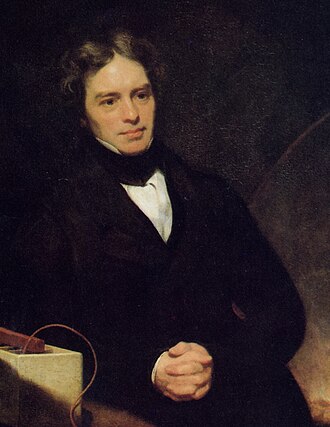
Fun Facts About Michael Faraday
- Michael Faraday's math did not extend as far as trigonometry and was limited to the simplest algebra. James Clerk Maxwell later put his discoveries into equations.[1]
- Faraday's first job was as a bookbinder's apprentice at age 14. During his seven-year apprenticeship he read many books.[1]
- Faraday sent chemist Humphry Davy a 300-page book of notes from Davy's lectures. When Davy damaged his eyesight in an accident, he hired Faraday as an assistant.[1]
- Faraday turned down a knighthood on religious grounds, preferring to remain "plain Mr Faraday to the end". He also twice refused to become President of the Royal Society.[1]
- Albert Einstein kept a portrait of Faraday on his study wall, alongside portraits of Isaac Newton and James Clerk Maxwell.[1][3][4][5][6]
- Faraday discovered benzene, which he called bicarburet of hydrogen, and invented an early form of the Bunsen burner.[1]
- Michael Faraday was alive at the same time as Sun Yat-sen — their lives overlapped for 1 year (1866–1867).[1][2][7][8]
- Michael Faraday and Friedrich Nietzsche died on the same day of the year, August 25.[1][2][9][10]
Michael Faraday was an English chemist and physicist who contributed vastly to the study of electrochemistry and electromagnetism. His main discoveries include the principles underlying electromagnetic induction, diamagnetism, and electrolysis. Although Faraday received little formal education, as a self-made man, he was one of the most influential scientists in history. It was by his research on the magnetic field around a conductor carrying a direct current that Faraday established the concept of the electromagnetic field in physics. Faraday also established that magnetism could affect rays of light and that there was an underlying relationship between the two phenomena. He similarly discovered the principles of electromagnetic induction, diamagnetism, and the laws of electrolysis. His inventions of electromagnetic rotary devices formed the foundation of electric motor technology, and it was largely due to his efforts that electricity became practical for use in technology. The SI unit of capacitance, the farad, is named after him.[1]
Read more on Wikipedia →Contemporaries
Their World
Questions About Michael Faraday
When was Michael Faraday born?
Michael Faraday was born on September 22, 1791, and died on August 25, 1867.
How old was Michael Faraday at death?
Michael Faraday was born on September 22, 1791, and died on August 25, 1867, at age 75.
What was Michael Faraday known for?
Michael Faraday was known for: Electromagnetic induction. Michael Faraday was an English chemist and physicist who contributed vastly to the study of electrochemistry and electromagnetism. His main discoveries include the principles underlying electromagnetic induction, diamagnetism, and electrolysis. Although Faraday received little formal education, as a self-made man, he was one of the most influential scientists in history. It was by his research on the magnetic field around a conductor carrying a direct current that Faraday established the concept of the electromagnetic field in physics. Faraday also established that magnetism could affect rays of light and that there was an underlying relationship between the two phenomena. He similarly discovered the principles of electromagnetic induction, diamagnetism, and the laws of electrolysis. His inventions of electromagnetic rotary devices formed the foundation of electric motor technology, and it was largely due to his efforts that electricity became practical for use in technology. The SI unit of capacitance, the farad, is named after him.
Who was alive at the same time as Michael Faraday?
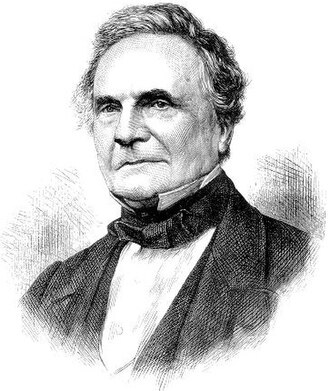
Michael Faraday's closest contemporary was Charles Babbage. Their lives overlapped for 76 years.
Sources
- Michael Faraday — Wikipedia. Text available under CC BY-SA 4.0
- Michael Faraday (Q8750) — Wikidata
- Albert Einstein — Wikipedia
- Albert Einstein (Q937) — Wikidata
- Isaac Newton — Wikipedia
- Isaac Newton (Q935) — Wikidata
- Sun Yat-sen — Wikipedia
- Sun Yat-sen (Q8573) — Wikidata
- Friedrich Nietzsche — Wikipedia
- Friedrich Nietzsche (Q9358) — Wikidata
- Portrait: M Faraday Th Phillips oil 1842.jpg — Wikimedia Commons. Thomas Phillips, Public domain