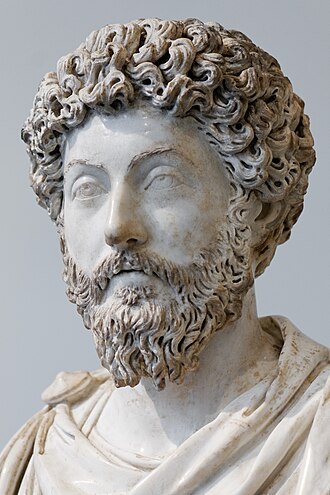
Fun Facts About Marcus Aurelius
- Marcus Aurelius wrote his Meditations in Greek for his own guidance while on campaign; the original title, if it had one, is unknown, and names like To Himself came later.[1]
- The bronze equestrian statue of Marcus Aurelius in Rome is the only Roman equestrian statue that has survived into the modern period.[1]
- A statue of Marcus once stood atop his victory column in Rome, but it disappeared in the Middle Ages, and in 1589 Pope Sixtus V replaced it with a statue of Saint Paul.[1][3][4]
- Rome had two emperors at once because of Marcus: he refused to take office unless his adoptive brother Lucius Verus received equal powers.[1]
- In 166 a Roman traveler reached the Han court in China claiming to represent "Andun", a ruler who may have been Marcus or his predecessor Antoninus.[1]
- The Meditations were a favorite book of Frederick the Great, John Stuart Mill, Matthew Arnold and Goethe.[1][5][6][7][8]
- Marcus Aurelius lived to about 59, from 121 until 180.[1][2]
Marcus Aurelius Antoninus was Roman emperor from 161 to 180 and a Stoic philosopher. He was a member of the Nerva–Antonine dynasty, the last of the rulers later known as the Five Good Emperors and the last emperor of the Pax Romana, an age of relative peace, calm, and stability for the Roman Empire lasting from 27 BC to 180 AD. He served as Roman consul in 140, 145, and 161.[1]
Read more on Wikipedia →Contemporaries
Questions About Marcus Aurelius
When was Marcus Aurelius born?
Marcus Aurelius was born in 121 and died in 180.
How old was Marcus Aurelius at death?
Marcus Aurelius died in 180 at about 59 years old (121–180).
What was Marcus Aurelius known for?
Marcus Aurelius was known for: Roman emperor and Stoic author of the Meditations. Marcus Aurelius Antoninus was Roman emperor from 161 to 180 and a Stoic philosopher. He was a member of the Nerva–Antonine dynasty, the last of the rulers later known as the Five Good Emperors and the last emperor of the Pax Romana, an age of relative peace, calm, and stability for the Roman Empire lasting from 27 BC to 180 AD. He served as Roman consul in 140, 145, and 161.
Sources
- Marcus Aurelius — Wikipedia. Text available under CC BY-SA 4.0
- Marcus Aurelius (Q1430) — Wikidata
- Paul the Apostle — Wikipedia
- Paul the Apostle (Q9200) — Wikidata
- Frederick the Great — Wikipedia
- Frederick the Great (Q33550) — Wikidata
- Johann Wolfgang von Goethe — Wikipedia
- Johann Wolfgang von Goethe (Q5879) — Wikidata
- Portrait: Marcus Aurelius Louvre MR561 n02.jpg — Wikimedia Commons. Marie-Lan Nguyen (2011), CC BY 2.5