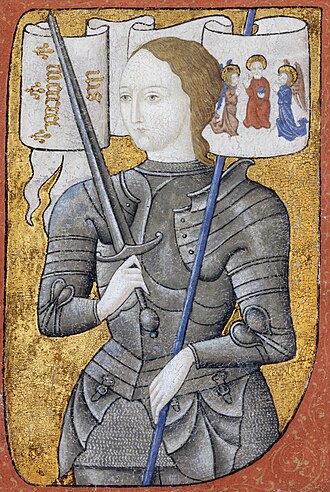
Fun Facts About Joan of Arc
- Joan of Arc may never have heard herself called "Jeanne d'Arc". She signed her letters "Jehanne", and the first written record of that name dates from 1455, 24 years after her death.[1]
- Joan was not taught to read or write as a child and dictated her letters, though she may later have learned to sign her name and perhaps even to read.[1]
- After her capture, Joan tried to escape Beaurevoir Castle by jumping from a tower window. She landed in a dry moat, injured but alive.[1]
- At Orléans, Joan was hit by an arrow between the neck and shoulder, but returned to rally the final assault on the English fortress. The siege ended the next day.[1]
- Joan had a sword brought to her from under the altar of a church at Sainte-Catherine-de-Fierbois, and she designed her own banner.[1]
- Joan's festival at Orléans was suspended during the French Revolution; Napoleon Bonaparte revived it in 1803 and authorized a new statue of her.[1][3][4]
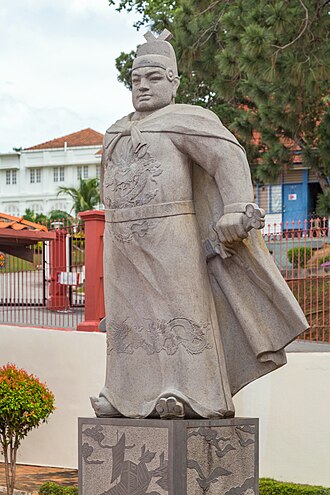
- Joan of Arc was alive at the same time as Zheng He — their lives overlapped for about 19 years (c. 1412–1431).[1][2][5][6]
- Joan of Arc and Voltaire died on the same day of the year, May 30.[1][2][7][8]
Joan of Arc is a patron saint of France, honored as a defender of the French nation for her role in the siege of Orléans and her insistence on the coronation of Charles VII of France during the Hundred Years' War. Stating that she acted under divine guidance, she became a military leader who gained recognition as a savior of France.[1]
Read more on Wikipedia →Contemporaries
Their World
Questions About Joan of Arc
When was Joan of Arc born?
Joan of Arc was born about 1412 and died on May 30, 1431.
How old was Joan of Arc at death?
Joan of Arc died in 1431 at about 19 years old (c. 1412–1431).
What was Joan of Arc known for?
Joan of Arc was known for: Heroine of France, military leader. Joan of Arc is a patron saint of France, honored as a defender of the French nation for her role in the siege of Orléans and her insistence on the coronation of Charles VII of France during the Hundred Years' War. Stating that she acted under divine guidance, she became a military leader who gained recognition as a savior of France.
Who was alive at the same time as Joan of Arc?
Joan of Arc's closest contemporary was Zheng He. Their lives overlapped for 19 years.
Sources
- Joan of Arc — Wikipedia. Text available under CC BY-SA 4.0
- Joan of Arc (Q7226) — Wikidata
- Napoleon — Wikipedia
- Napoleon Bonaparte (Q517) — Wikidata
- Zheng He — Wikipedia
- Zheng He (Q7333) — Wikidata
- Voltaire — Wikipedia
- Voltaire (Q9068) — Wikidata
- Portrait: Joan of Arc miniature graded.jpg — Wikimedia Commons. Unknown author, Public domain