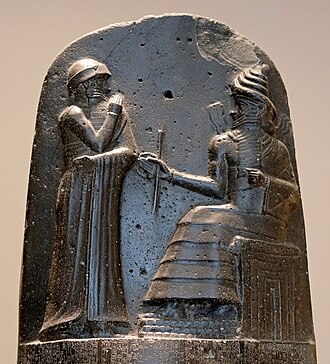
Hammurabi
Politics & Leadership
Fun Facts About Hammurabi
- Hammurabi is the Mesopotamian king with the most known letters, just over 200, and they show him dealing with matters as small as single servants and small lots of land.[1]
- Hammurabi is one of 23 lawgivers in marble reliefs in the chamber of the US House of Representatives, and he also appears in a frieze on the US Supreme Court building.[1]
- Hammurabi's code says he set up its stela in Babylon, but the stela was unearthed at Susa, in present-day Iran, by a French archaeological team in 1901–1902.[1]
- The only confirmed depiction of Hammurabi is the one on the stela of his law code. Other images said to show him are disputed.[1]
- Hammurabi's code invited any wronged man to come before the king's statue and have the inscribed stela read aloud to him.[1]
- In Hammurabi's time each year was named after a notable event of the year before, such as a military victory or the digging of a canal.[1]
Hammurabi, also spelled Hammurapi, was the sixth Amorite king of Babylon, reigning from c. 1792 BC to c. 1750 BC. He was preceded by his father, Sin-muballit.[1]
Read more on Wikipedia →Contemporaries
Questions About Hammurabi
When was Hammurabi born?
Hammurabi was born about 1810 BCE and died about 1750 BCE. The exact dates are not known.
What was Hammurabi known for?
Hammurabi was known for: Babylonian king of the Code of Hammurabi. Hammurabi, also spelled Hammurapi, was the sixth Amorite king of Babylon, reigning from c. 1792 BC to c. 1750 BC. He was preceded by his father, Sin-muballit.
Sources
- Hammurabi — Wikipedia. Text available under CC BY-SA 4.0
- Hammurabi (Q36359) — Wikidata
- Portrait: F0182 Louvre Code Hammourabi Bas-relief Sb8 rwk.jpg — Wikimedia Commons. Mbzt, CC BY 3.0