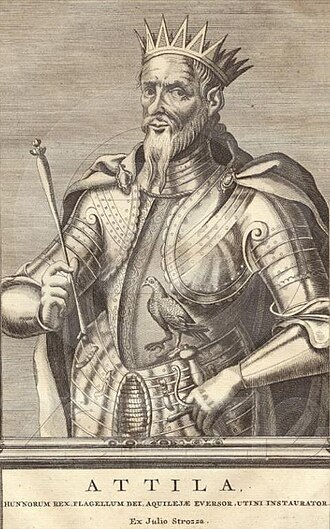
Fun Facts About Attila the Hun
- Attila the Hun's name most likely means "little father": most scholars derive it from the Gothic word atta, "father", plus a diminutive suffix.[1]
- When the Roman princess Honoria sent Attila a plea for help with her engagement ring, he treated it as a marriage proposal and demanded half the Western Empire as dowry.[1]
- Attila's invasion of Italy in 452 played a part in the origins of Venice: people fleeing his attacks settled on small islands in the Venetian Lagoon.[1]
- According to the historian Priscus, Attila died after the feast for his wedding to a young woman named Ildico, possibly choking on a nosebleed in a stupor.[1]
- According to the account preserved by Jordanes, Attila was buried in secret at night in three coffins bound with gold, silver and iron.[1]
- Calling Germans "Huns" in World War I propaganda traced back to a 1900 speech in which Kaiser Wilhelm II praised Attila's military brutality.[1]
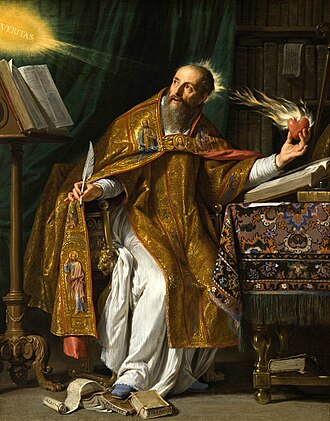
- Attila the Hun was alive at the same time as Augustine of Hippo — their lives overlapped for about 24 years (c. 406–430).[1][2][3][4]
- Attila the Hun lived to about 47, from c. 406 until 453.[1][2]
Attila, frequently called Attila the Hun, was the ruler of the Huns from 434 until his death in early 453. He was also the leader of an empire consisting of Huns, Ostrogoths, Alans, and Gepids, among others, in Central and Eastern Europe.[1]
Read more on Wikipedia →Contemporaries
Questions About Attila the Hun
When was Attila the Hun born?
Attila the Hun was born about 406 and died in 453.
How old was Attila the Hun at death?
Attila the Hun died in 453 at about 47 years old (c. 406–453).
What was Attila the Hun known for?
Attila the Hun was known for: Ruler of the Hunnic Empire. Attila, frequently called Attila the Hun, was the ruler of the Huns from 434 until his death in early 453. He was also the leader of an empire consisting of Huns, Ostrogoths, Alans, and Gepids, among others, in Central and Eastern Europe.
Who was alive at the same time as Attila the Hun?
Attila the Hun's closest contemporary was Augustine of Hippo. Their lives overlapped for 24 years.
Sources
- Attila — Wikipedia. Text available under CC BY-SA 4.0
- Attila the Hun (Q36724) — Wikidata
- Augustine of Hippo — Wikipedia
- Augustine of Hippo (Q8018) — Wikidata
- Portrait: Attila Hunnorum Rex Flagellum Dei Aquilejae Eversor Utini Instaurator.jpg — Wikimedia Commons. Julio Strozza, Public domain