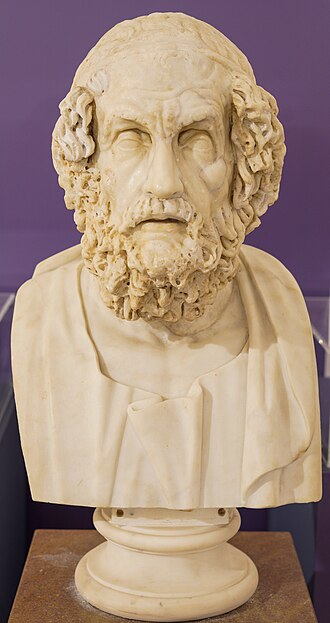
Fun Facts About Homer
- Homer is traditionally pictured as a blind bard, but scholars still debate whether he existed, and most now regard the Iliad and the Odyssey as the works of separate authors.[1]
- Nobody knows where the name "Homer" comes from. One ancient theory linked it to hómēros, a Greek word meaning hostage or surety.[1]
- In antiquity Homer was also credited with "The Frog–Mouse War" (Batrachomyomachia), a comic mini-epic.[1]
- One ancient tradition held that Homer failed to solve a riddle set by fishermen, and most accounts of his death place it on the Greek island of Ios.[1]
- The English scholar Richard Bentley argued that Homer wrote the Iliad for men and the Odyssey for women.[1]
- After studying folk bards in the Balkans starting around 1928, Milman Parry and Albert Lord developed the theory that the Homeric poems were first composed through improvised oral performance.[1]
Homer was an ancient Greek poet who is widely credited as the author of the Iliad and the Odyssey, two epic poems that are foundational works of ancient Greek literature. Although his life and authorship remain obscure, Homer was highly revered in ancient Greek society and is considered one of the most influential authors in history.[1]
Read more on Wikipedia →Contemporaries
Questions About Homer
When was Homer born?
Homer was born about 750 BCE and died about 650 BCE. The exact dates are not known.
What was Homer known for?
Homer was known for: Author of the Iliad and the Odyssey. Homer was an ancient Greek poet who is widely credited as the author of the Iliad and the Odyssey, two epic poems that are foundational works of ancient Greek literature. Although his life and authorship remain obscure, Homer was highly revered in ancient Greek society and is considered one of the most influential authors in history.
Sources
- Homer — Wikipedia. Text available under CC BY-SA 4.0
- Homer (Q6691) — Wikidata
- Portrait: Homer bust, Farnese collection (Naples).jpg — Wikimedia Commons. NikonZ7II, CC BY-SA 4.0